Sound more natural with Question Tags

Understanding question tags is easy, isn’t it?


Question tags are very common in spoken English. They are the short questions that we add on the end of sentences, the purpose of which is to turn a statement into a question.

Why do we use them?


Usually, a question tag is added to a statement, to allow us to confirm if the information is true or not.

You are from America, aren’t you?


But they can also be used to allow you to comment on a situation.

That movie was great, wasn’t it?


Or to find out more information.

You haven’t seen my car keys, have you?


There are lots of different question tags but the rules are not difficult to learn. Here is a simple graphic to explain almost everything.
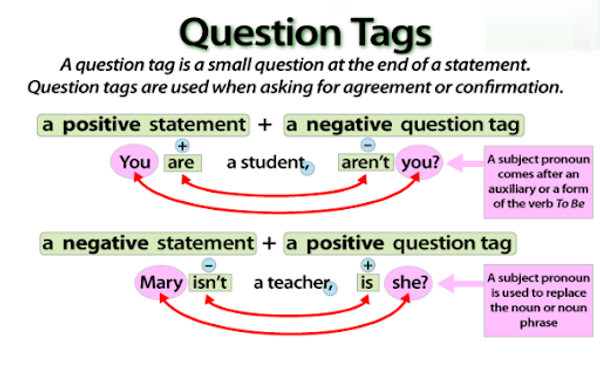


As you can see, if the main clause is positive, then the question tag is negative and vice versa.

So, to use Question Tags effectively, you need to know how to create and use both Positive and Negative sentences and when you speak, you should remember to use contractions.

It sounds easy, doesn’t it?


It sounds easy (Simple Present Positive)
It does not sound easy (Simple Present Negative)
Does not = Doesn’t (Contraction)

If you would like to learn more about Question Tags and how to use them I can recommend this YouTube tutorial:


Once you have mastered Question Tags, you might also want to learn to use Embedded Questions or Open & Closed Question forms. Asking questions is much more interesting than just learning the W? words.

Learn more Beautiful British English with Tutor Paul here on Verbling.

30 de Outubro de 2019

Profile Picture
US$ 45
USD/h

Paul O'Neill

security_checked
5.0
US$ 45
USD/h
Flag
Inglês
globe
Reino Unido
time
2.598
Fala:
Inglês
Nativo
,
Italiano
B2
You know your English is good enough. So why does it feel so difficult to speak up in that meeting, lead that presentation, or push back in a negotiation? The problem isn’t your grammar. It’s your confidence. I’m Paul, a British English coach with 20 years of experience helping professionals communicate with the same confidence in English that they already have in their own language. I specialise in business English for non-native speakers at B1 level and above. In our lessons, we work on real situations you face at work: team meetings, client presentations, negotiations, and delivering difficult news. I use proven communication frameworks (like PREP, SPIN, and STAR) to give you practical tools you can use the same day. My approach is simple. I believe the best communicators in English as a second language aren’t the ones with perfect grammar. They’re the ones with the confidence to stand up and speak without overthinking every word. That’s what I help you build. If you w...
Flag
Inglês
globe
Reino Unido
time
2.598
Fala:
Inglês
Nativo
,
Italiano
B2
You know your English is good enough. So why does it feel so difficult to speak up in that meeting, lead that presentation, or push back in a negotiation? The problem isn’t your grammar. It’s your confidence. I’m Paul, a British English coach with 20 years of experience helping professionals communicate with the same confidence in English that they already have in their own language. I specialise in business English for non-native speakers at B1 level and above. In our lessons, we work on real situations you face at work: team meetings, client presentations, negotiations, and delivering difficult news. I use proven communication frameworks (like PREP, SPIN, and STAR) to give you practical tools you can use the same day. My approach is simple. I believe the best communicators in English as a second language aren’t the ones with perfect grammar. They’re the ones with the confidence to stand up and speak without overthinking every word. That’s what I help you build. If you w...
Mi vida antes del Covid- 19 (IMPERFECTO) A-2
Profile Picture
Alejandra Santiago
7 de Agosto de 2020
팔랑귀
Profile Picture
Abby H
7 de Agosto de 2020
The Origins of popular English Idioms
Profile Picture
Jen Mc Monagle
7 de Agosto de 2020